
 { model }
Domain Modeling
Do not model the current state of the world, model how you get there
event sourcing by example
Discover
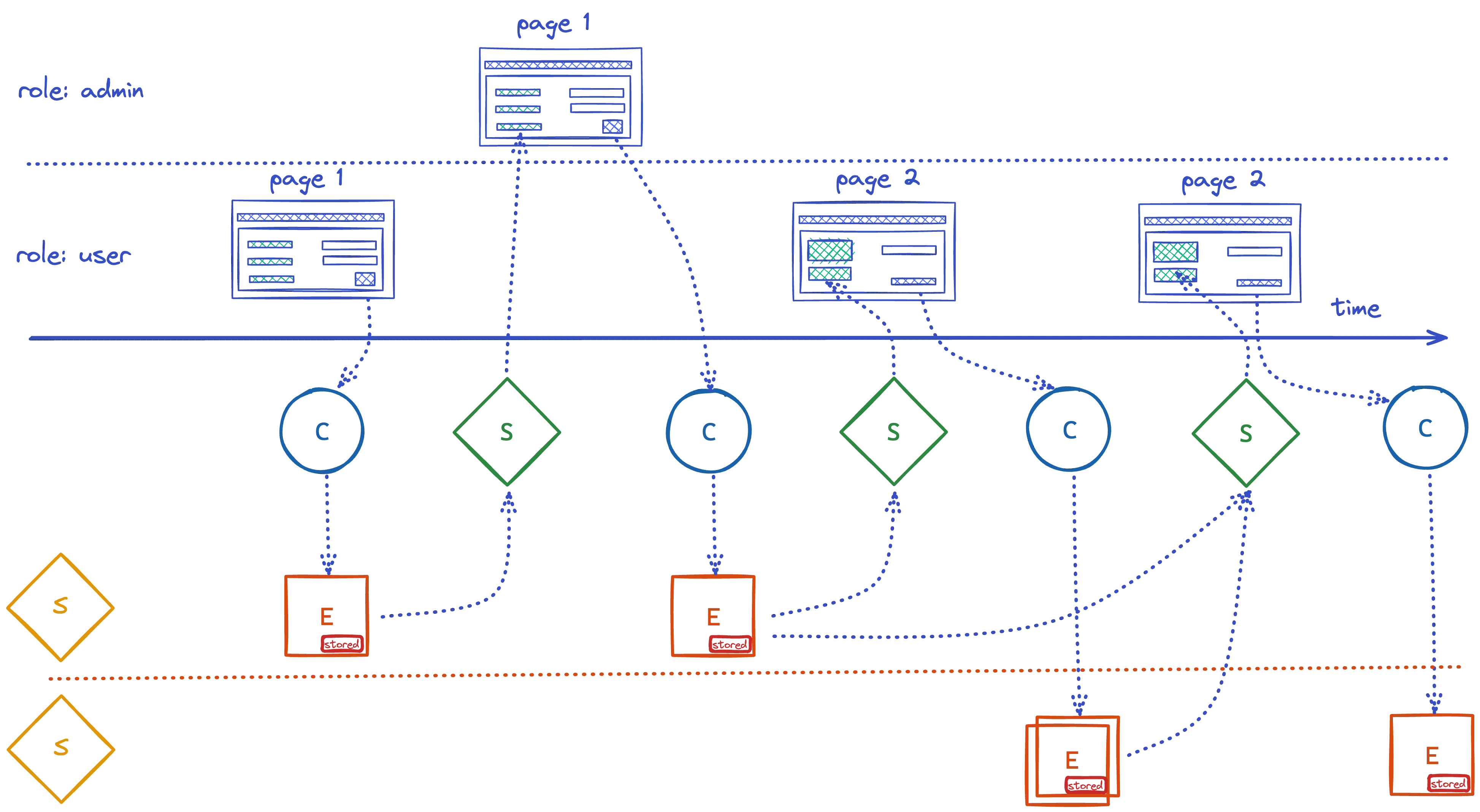
We can illustrate a system’s expected behavior from start to finish on a timeline, without branching, using a concrete example.
Event Modeling is a powerful technique for exploring a domain. It describes systems by tracing how information changes over time through key events.
Deno.test(function changeRestaurantMenuDeciderTest() {
  const changeRestaurantMenuCommand: RestaurantCommand = restaurantCommandSchema
    .parse(
      JSON.parse(changeRestaurantMenuCommandJson),
    );

  const restaurantCreatedEvent: RestaurantEvent = restaurantEventSchema
    .parse(
      JSON.parse(restaurantCreatedEventJson),
    );

  const restaurantMenuChangedEvent: RestaurantEvent = restaurantEventSchema
    .parse(
      JSON.parse(restaurantMenuChangedEventJson),
    );

  DeciderSpecification.for(restaurantDecider)
    .given([restaurantCreatedEvent])
    .when(changeRestaurantMenuCommand)
    .then([restaurantMenuChangedEvent]);
});Distill
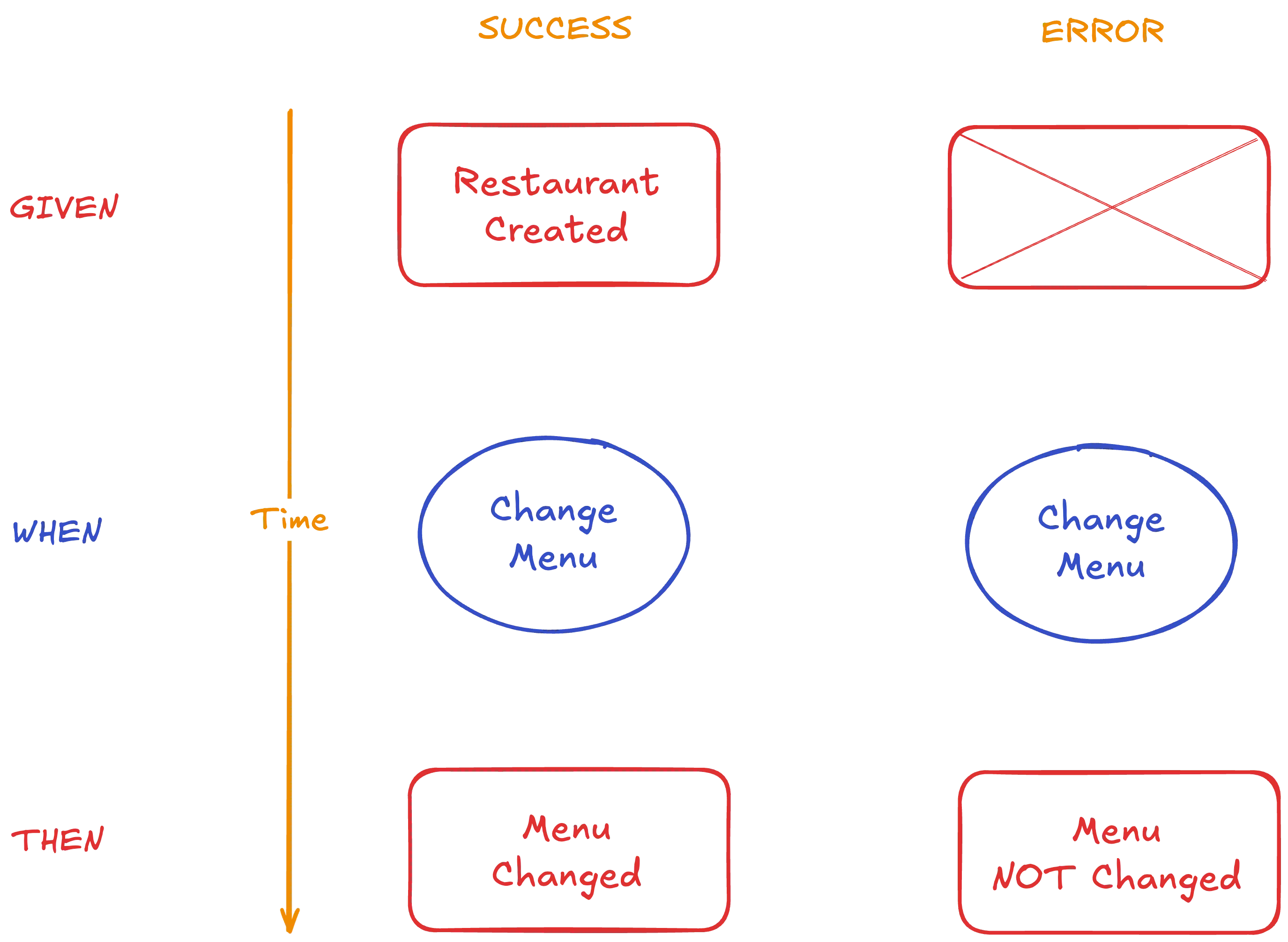
Requirements are expressed as scenarios.
A scenario represents the system's behavior from the user's perspective and follows the Given-When-Then structure to create a testable specification.
The specification is written as executable tests, which are automated and run continuously. These tests cover a full range of scenarios, from happy paths to error cases.
Develop
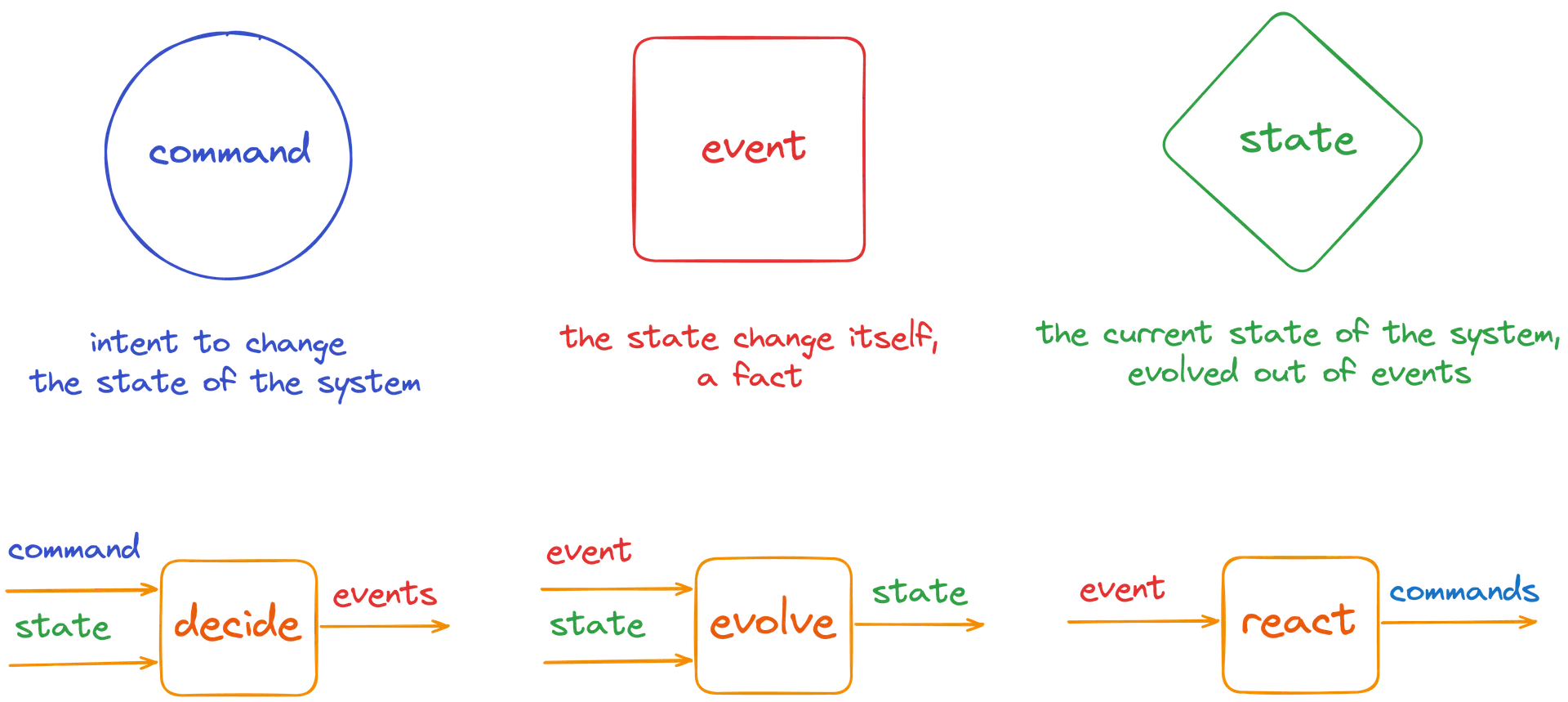
The f { model } library is implementing the event model in a general way. It promotes clear separation between data and behaviour.
The flow is parametrized with Command, Event, and State parameters. The responsibility of the business is to specialize in their case by specifying concrete Commands, Events, and State. For example, Commands=CreateOrder, AddItemToOrder; Events=OrderCreated, ItemAdded; State=Order (with list of Items).
// Restaurant Commands
export type RestaurantCommand =
  | CreateRestaurantCommand
  | ChangeRestaurantMenuCommand
  | PlaceOrderCommand;

export type CreateRestaurantCommand = {
  readonly decider: "Restaurant";
  readonly kind: "CreateRestaurantCommand";
  readonly id: RestaurantId;
  readonly name: RestaurantName;
  readonly menu: RestaurantMenu;
};
export type ChangeRestaurantMenuCommand = {
  readonly decider: "Restaurant";
  readonly kind: "ChangeRestaurantMenuCommand";
  readonly id: RestaurantId;
  readonly menu: RestaurantMenu;
};
// A Restaurant Decider
export const restaurantDecider: Decider<
  RestaurantCommand,
  Restaurant | null,
  RestaurantEvent
> = new Decider<RestaurantCommand, Restaurant | null, RestaurantEvent>(
  (command, currentState) => {
    // Ehaustive switch/pattern matching
    switch (command.kind) {
      case "CreateRestaurantCommand":
      ...
Libraries (Kotlin | Rust | TypeScript)
Open-source libraries for functional domain modeling. Need help implementing these patterns in your organization? Explore our professional services
f{model} in Kotlin
Lightweight Kotlin library enabling functional and reactive domain modeling patterns
f(&model) in Rust
Lightweight Rust library enabling functional and safe domain modeling patterns
f(model) in TypeScript
Lightweight TypeScript library enabling functional and algebraic domain modeling patterns
Database
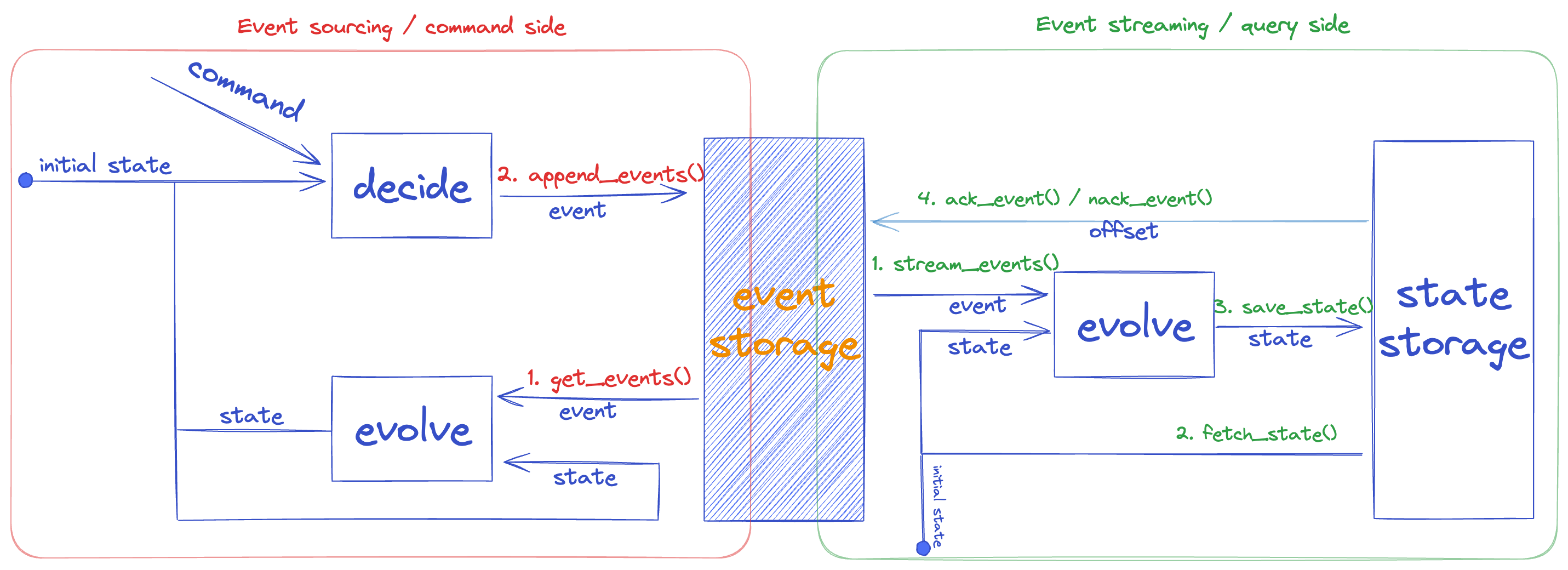
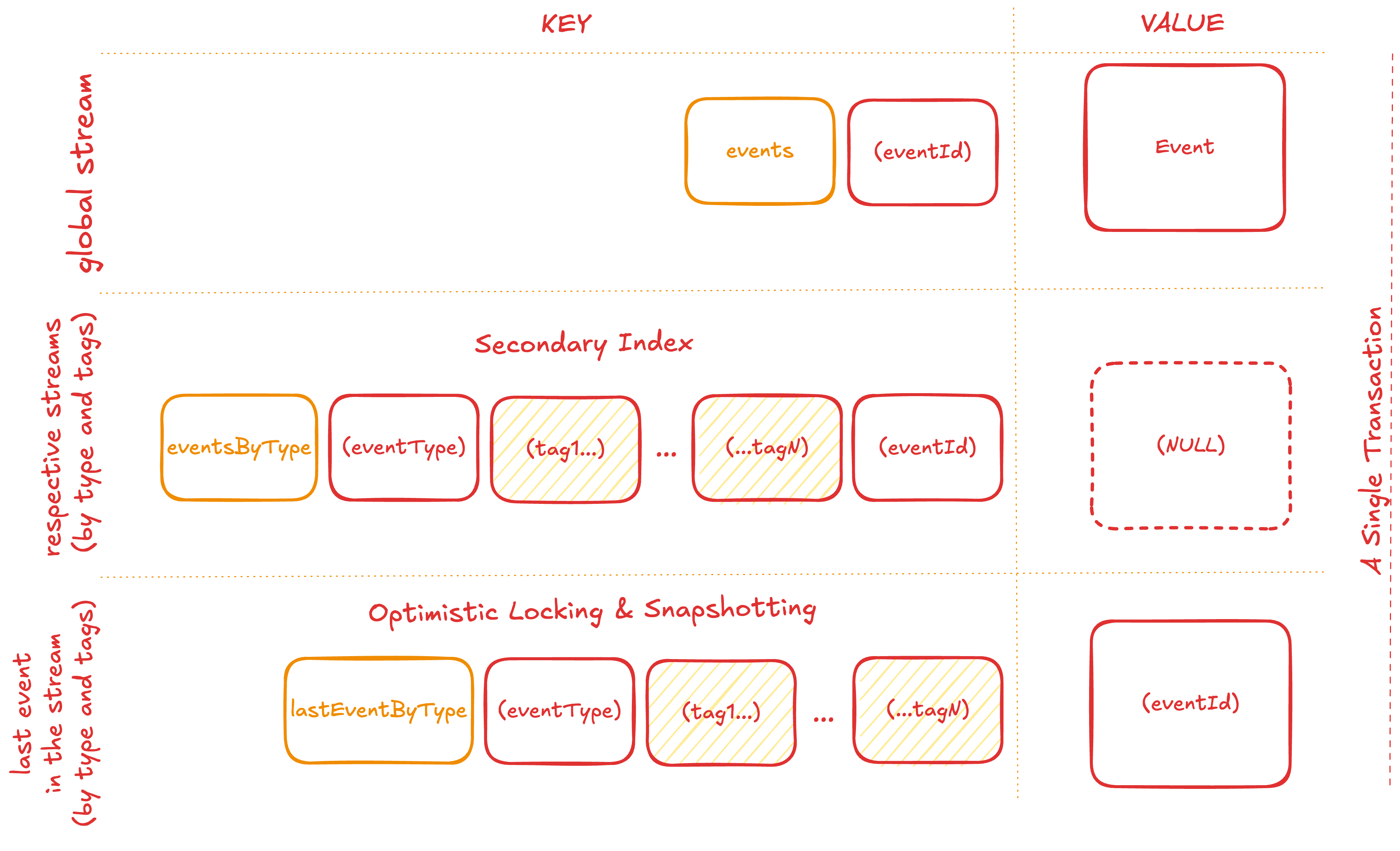
event-sourcing and event-streaming with PostgreSQL, FoundationDB, DenoKV, TiKV database.
Optimistic Locking- for concurrency controlConcurrent Consumers- for efficient streamingAt-Least-Once Delivery- to ensure reliability
No additional tools, frameworks, or programming languages are required at this level.